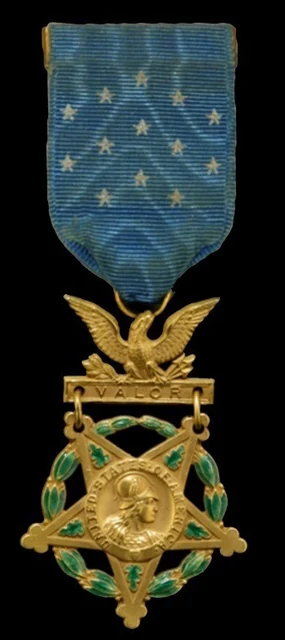
- Rank at action
- Captain
- Service
- U.S. Army Air Corps
- Conflict
- World War II
- Unit or command
- Heavy Bombardment Squadron, 19th Bombardment Group, 509th Bombardment Wing, 5th Air Force
- Presentation date
- November 4, 1942
For conspicuous gallantry and intrepidity above and beyond the call of duty in action with the enemy on 6-7 August 1942. When 1 engine of the bombardment airplane of which he was pilot failed during a bombing mission over New Guinea, Capt. Pease was forced to return to a base in Australia. Knowing that all available airplanes of his group were to participate the next day in an attack on an enemy-held airdrome near Rabaul, New Britain, although he was not scheduled to take part in this mission, Capt. Pease selected the most serviceable airplane at this base and prepared it for combat, knowing that it had been found and declared unserviceable for combat missions. With the members of his combat crew, who volunteered to accompany him, he rejoined his squadron at Port Moresby, New Guinea, at 1 a.m. on 7 August, after having flown almost continuously since early the preceding morning. With only 3 hours' rest, he took off with his squadron for the attack. Throughout the long flight to Rabaul, New Britain, he managed by skillful flying of his unserviceable airplane to maintain his position in the group. When the formation was intercepted by about 30 enemy fighter airplanes before reaching the target, Capt. Pease, on the wing which bore the brunt of the hostile attack, by gallant action and the accurate shooting by his crew, succeeded in destroying several Zeros before dropping his bombs on the hostile base as planned, this in spite of continuous enemy attacks. The fight with the enemy pursuit lasted 25 minutes until the group dived into cloud cover. After leaving the target, Capt. Pease's aircraft fell behind the balance of the group due to unknown difficulties as a result of the combat, and was unable to reach this cover before the enemy pursuit succeeded in igniting 1 of his bomb bay tanks. He was seen to drop the flaming tank. It is believed that Capt. Pease's airplane and crew were subsequently shot down in flames, as they did not return to their base. In voluntarily performing this mission Capt. Pease contributed materially to the success of the group, and displayed high devotion to duty, valor, and complete contempt for personal danger. His undaunted bravery has been a great inspiration to the officers and men of his unit.
Sources & record notes
General Order comparison: pending. Current-profile review does not mean that the underlying original order has been examined.
- Harl Pease Jr — current Society profile ↗Congressional Medal of Honor Society · Checked 2026-08-31
current identity, service, action metadata, and citation comparison
Transcription, metadata & provenance notes
- Award ID
- MOH-AW-002606
- Transcription status
- Legacy full text · current reference profile matched
- Last source check
- 2026-08-31
- Recorded order reference (not verified against the original)
- 59
- Entered service at
- Plymouth, N.H.
- Archive transcription SHA-256
- c91c220c270bc442806ae42ba84d054ab9630e8adc1185d09d935563c901626e
Legacy transcription retained without substantive editing; rendered current reference profile variants documented in the Phase 10 evidence snapshot.
Current reference profile confirms the Army Air Corps unit and August 6–7, 1942 action range. Its structured action-place spelling 'New Britian' is preserved separately while New Britain is controlled for display. Recovery provenance: the prior live-verification result is reconstructed because the described P10-C060–P10-C062 restart files were not physically available; the verified P10-C059 authority, retained web-reference metadata, legacy record, and prior session evidence are all preserved.