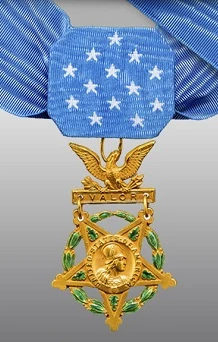
- Rank at action
- Major
- Service
- U.S. Army
- Conflict
- Vietnam War
- Unit or command
- 229th Assault Helicopter Battalion, 1st Cavalry Division (Airmobile)
- Presentation date
- February 26, 2007
For conspicuous gallantry and intrepidity at the risk of his life above and beyond the call of duty: Major Bruce P. Crandall distinguished himself by extraordinary heroism as a Flight Commander in the Republic of Vietnam, while serving with Company A, 229th Assault Helicopter Battalion, 1st Cavalry Division (Airmobile). On 14 November 1965, his flight of sixteen helicopters was lifting troops for a search and destroy mission from Plei Me, Vietnam, to Landing Zone X-Ray in the Ia Drang Valley. On the fourth troop lift, the airlift began to take enemy fire, and by the time the aircraft had refueled and returned for the next troop lift, the enemy had Landing Zone X-Ray targeted. As Major Crandall and the first eight helicopters landed to discharge troops on his fifth troop lift, his unarmed helicopter came under such intense enemy fire that the ground commander ordered the second flight of eight aircraft to abort their mission. As Major Crandall flew back to Plei Me, his base of operations, he determined that the ground commander of the besieged infantry batallion desperately needed more ammunition. Major Crandall then decided to adjust his base of operations to Artillery Firebase Falcon in order to shorten the flight distance to deliver ammunition and evacuate wounded soldiers. While medical evacuation was not his mission, he immediately sought volunteers and with complete disregard for his own personal safety, led the two aircraft to Landing Zone X-Ray. Despite the fact that the landing zone was still under relentless enemy fire, Major Crandall landed and proceeded to supervise the loading of seriously wounded soldiers aboard his aircraft. Major Crandall's voluntary decision to land under the most extreme fire instilled in the other pilots the will and spirit to continue to land their own aircraft, and in the ground forces the realization that they would be resupplied and that friendly wounded would be promptly evacuated. This greatly enhanced morale and the will to fight at a critical time. After his first medical evacuation, Major Crandall continued to fly into and out of the landing zone throughout the day and into the evening. That day he completed a total of 22 flights, most under intense enemy fire, retiring from the battlefield only after all possible service had been rendered to the Infantry battalion. His actions provided critical resupply of ammunition and evacuation of the wounded. Major Crandall's daring acts of bravery and courage in the face of an overwhelming and determined enemy are in keeping with the highest traditions of the military service and reflect great credit upon himself, his unit, and the United States Army.
Sources & record notes
General Order comparison: pending. Current-profile review does not mean that the underlying original order has been examined.
- Bruce P. Crandall — current Society profile ↗Congressional Medal of Honor Society · Checked 2026-08-30
current identity, service, action metadata, and citation comparison
Transcription, metadata & provenance notes
- Award ID
- MOH-AW-002022
- Transcription status
- Legacy full text · current reference profile matched
- Last source check
- 2026-08-30
- Later or highest recorded rank
- Colonel
- Entered service at
- Olympia, WA
- Accredited to
- Olympia, WA
- Archive transcription SHA-256
- 3d2094eaa17e3aed6b44bb81e34ebfab4f1c78b419adbfb512859998c82339dc
Legacy transcription retained without substantive editing; rendered current reference profile variants documented in the Phase 10 evidence snapshot.
The controlled action rank is Major. The inherited rank is Major; the current profile also records Major (Highest Rank: Colonel). Action, presentation, and later/highest ranks remain separately attributed. The current authoritative unit wording is 229th Assault Helicopter Battalion, 1st Cavalry Division (Airmobile); the inherited unit Company A, 229th Assault Helicopter Battalion, 1st Cavalry Division remains preserved as a source variant. The current historical action-place wording replaces only the controlled canonical geocoder field; the complete inherited place remains preserved. The current authoritative profile classifies the action under Vietnam War; the inherited Not yet classified value remains preserved in the audit record.